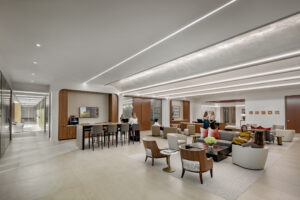
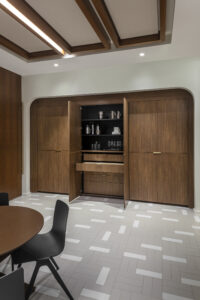
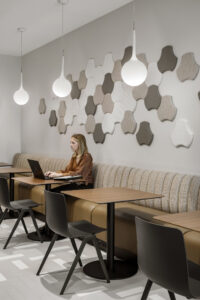
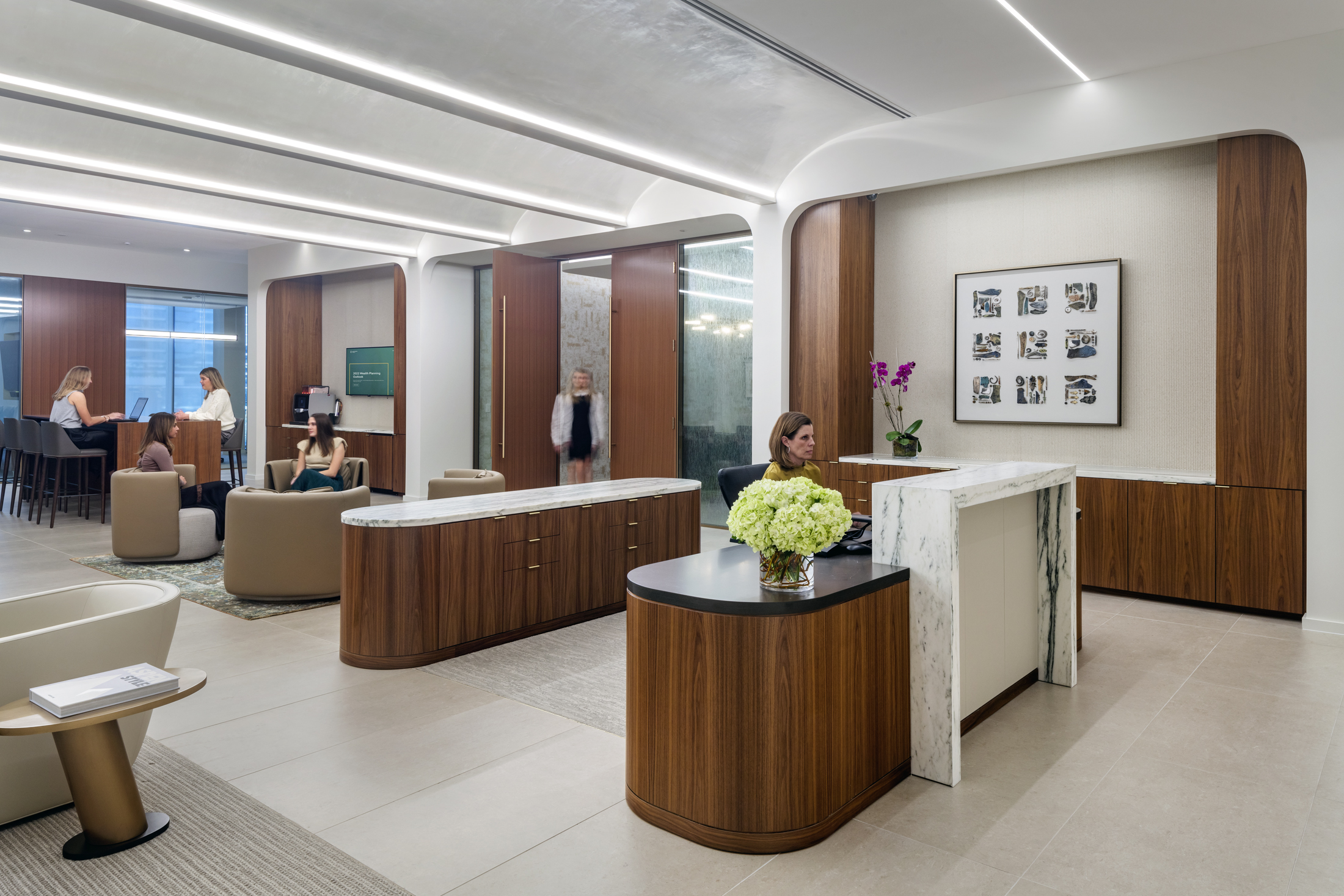
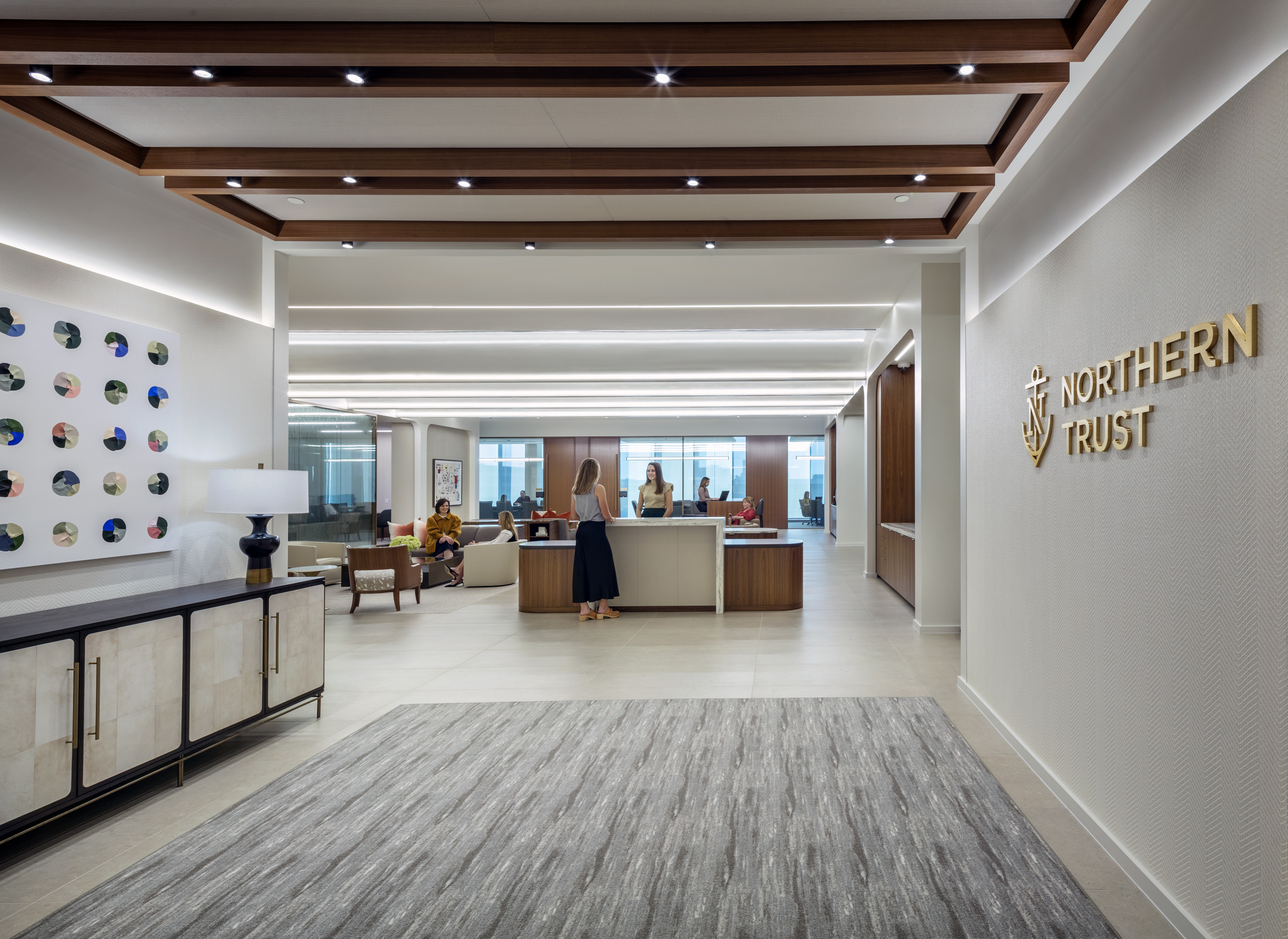
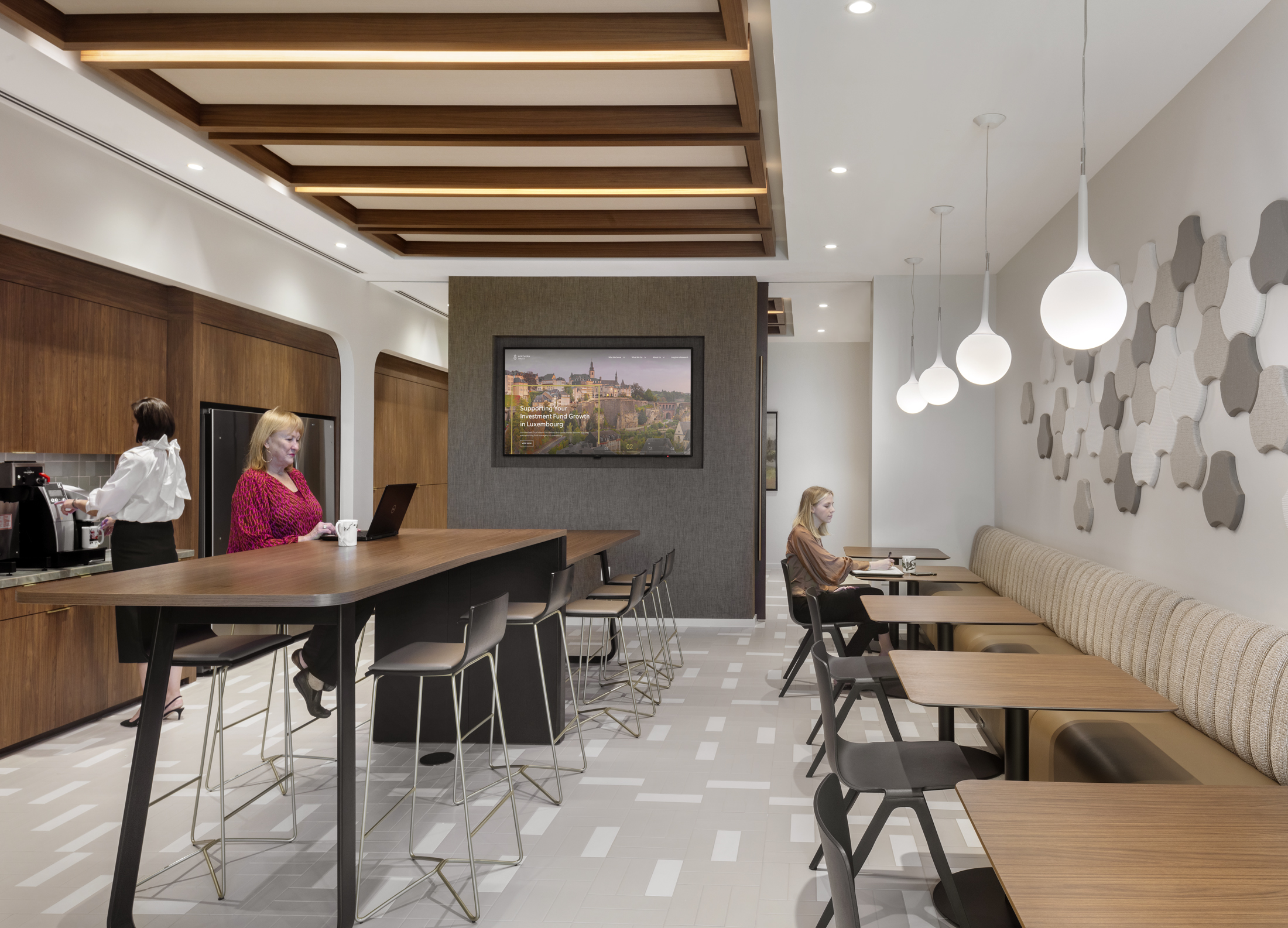
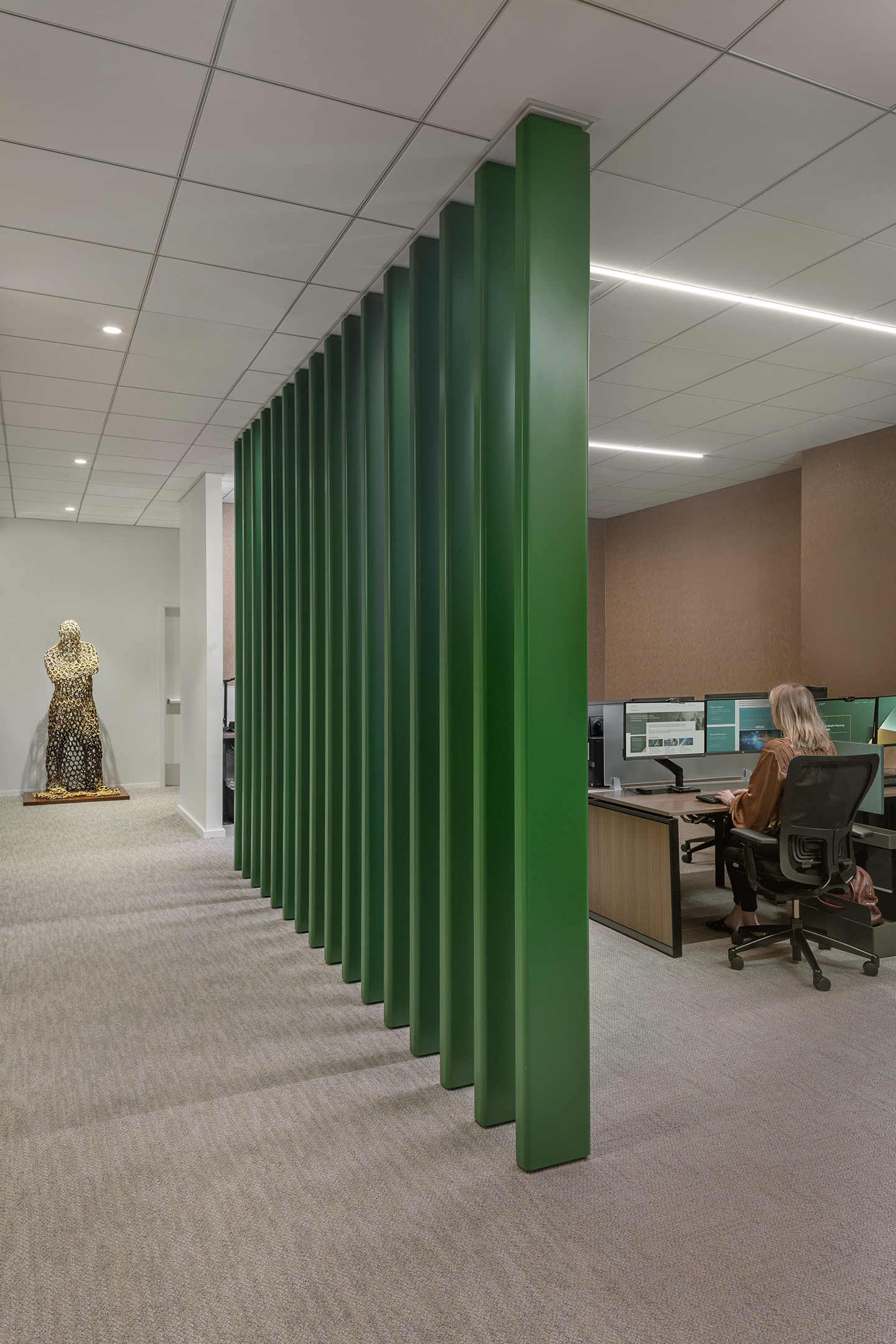
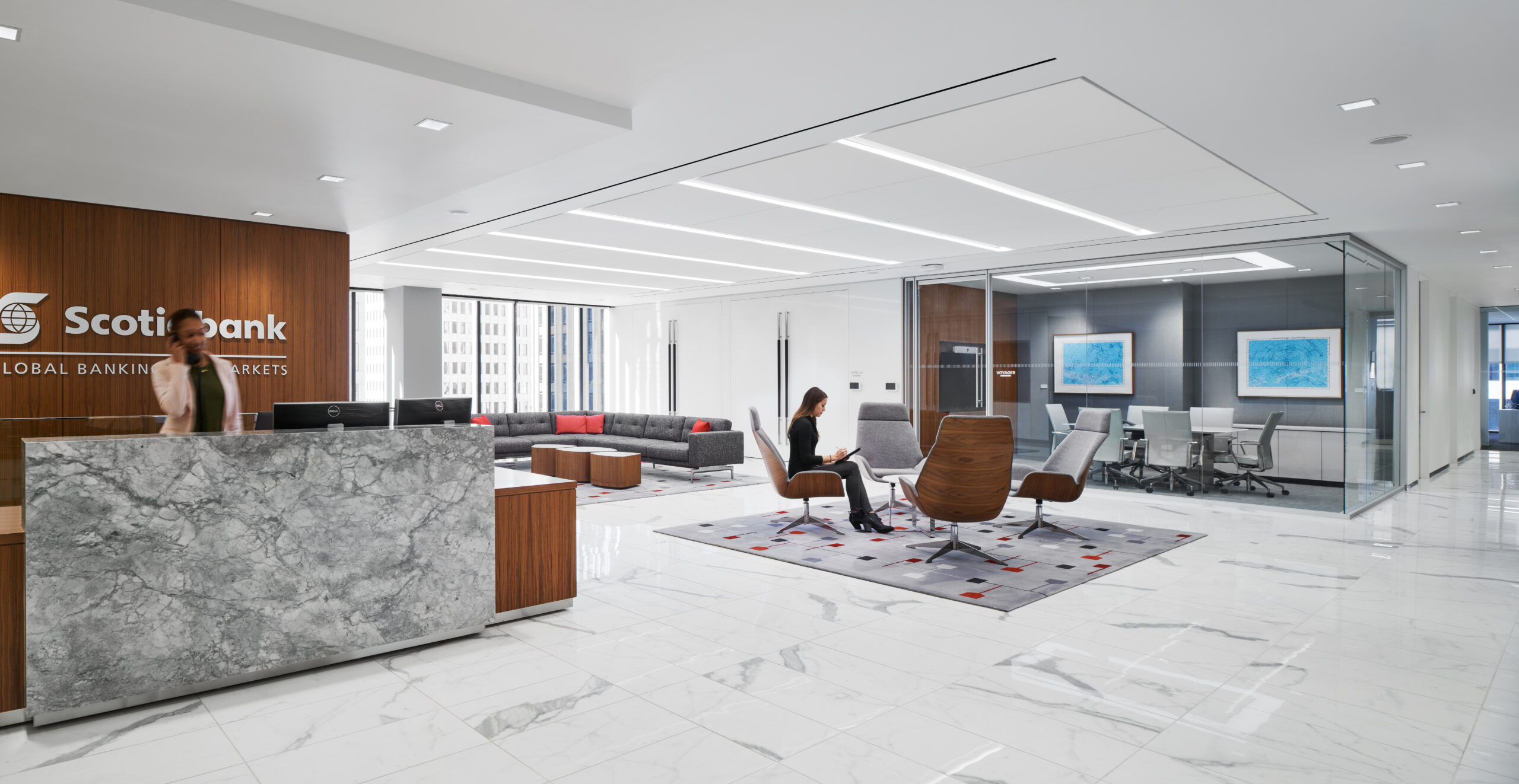
We’re proud to share that Acacia has been featured in the Spring 2026 issue of Design Solutions Magazine, published by the Architectural Woodwork Institute, for our work on the Briarlake Plaza repositioning in Houston, Texas.

It’s an honor to see this project recognized on a national stage, and a reflection of what happens when great design partners trust each other enough to solve hard problems together.

Read the full feature in Design Solutions Magazine here.

The Challenge: Two Buildings, Two Very Different Experiences

Briarlake Plaza sits in Houston’s Memorial Corridor— a two-building, 835,000-square-foot office campus owned by Cousins Properties. On paper, the two buildings should have offered a unified workplace experience. In reality, they didn’t.

Briarlake Two had ground-floor food and beverage options and steady tenant engagement. Briarlake One was a different story: high vacancy rates, outdated common areas, and a lobby that felt more like a pass-through than a destination. The campus needed more than a cosmetic refresh. It needed a cohesive identity that would attract tenants, retain them, and give people a reason to actually want to be in the building.

That’s the brief Gensler took on. And it’s the kind of challenge where material choices stop being decorative and start becoming strategic.

The Design Strategy: Wood as the Unifying Thread

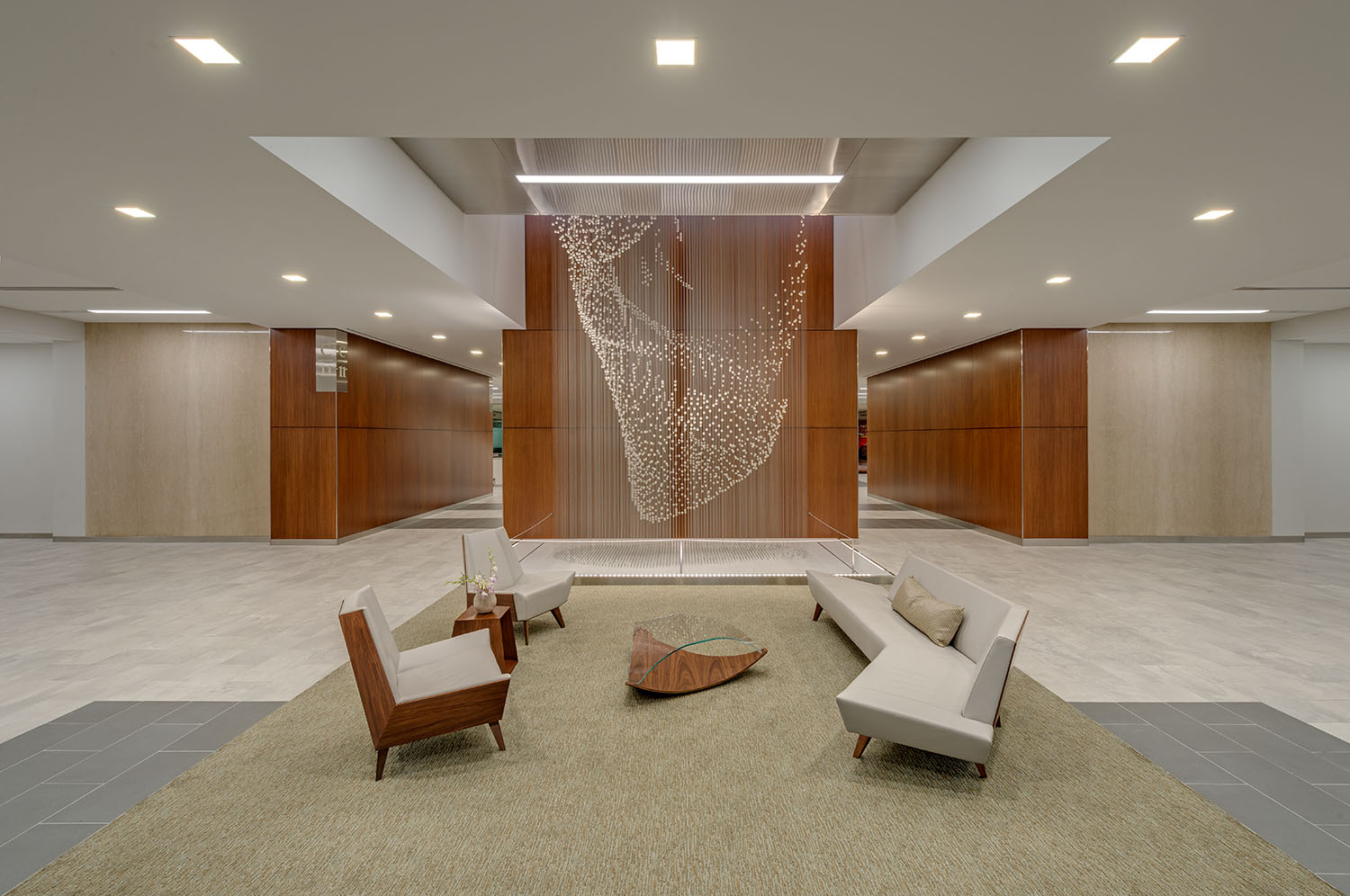
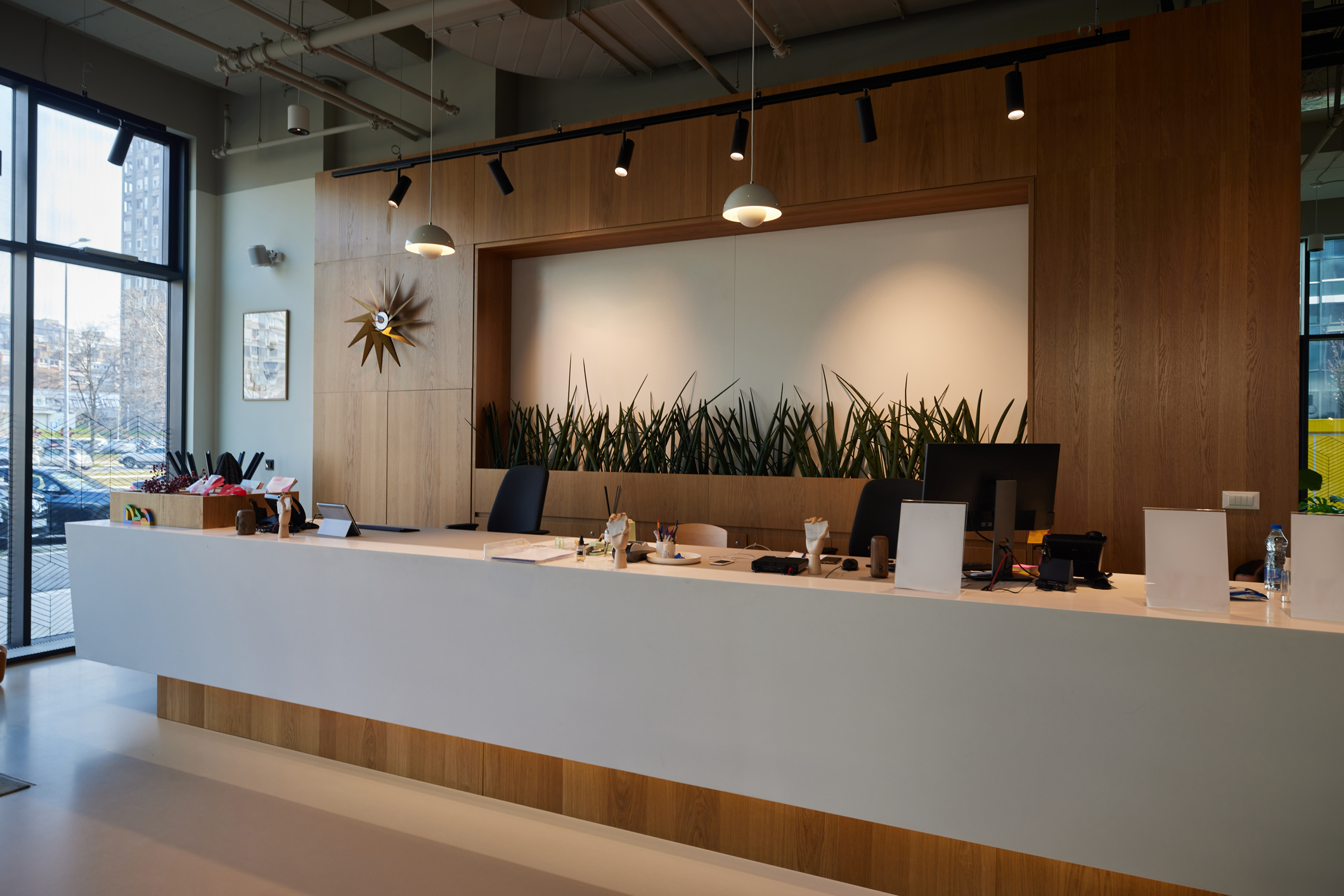
When the Gensler team, led by designer Jill Archibald, began reimagining Briarlake One, the first move was rethinking the lobby entirely. Vacant ground-level office space was repurposed to expand the lobby footprint. Management offices were relocated. A section of staircase was removed to open circulation. The reception desk was repositioned. What had been a fragmented arrival experience became a social hub with open lounge seating, indoor cabanas, and third-space work environments that blur the line between workplace and hospitality.

The lower level, previously an afterthought, was reinvented as a full amenity suite, including a fitness studio, golf simulator, gaming lounge, and flexible event space with catering capabilities.

Across all of it, wood became the connective tissue.

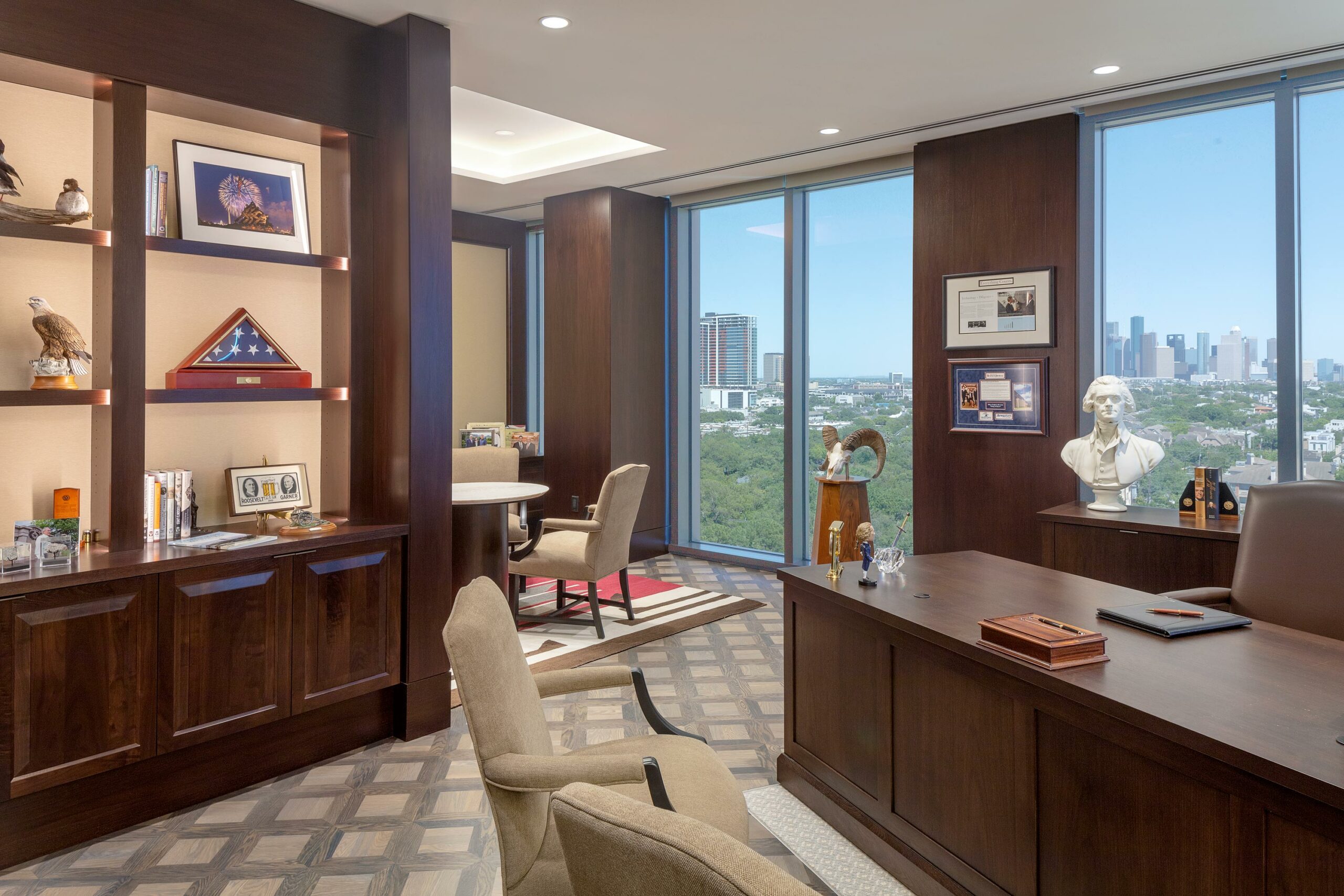
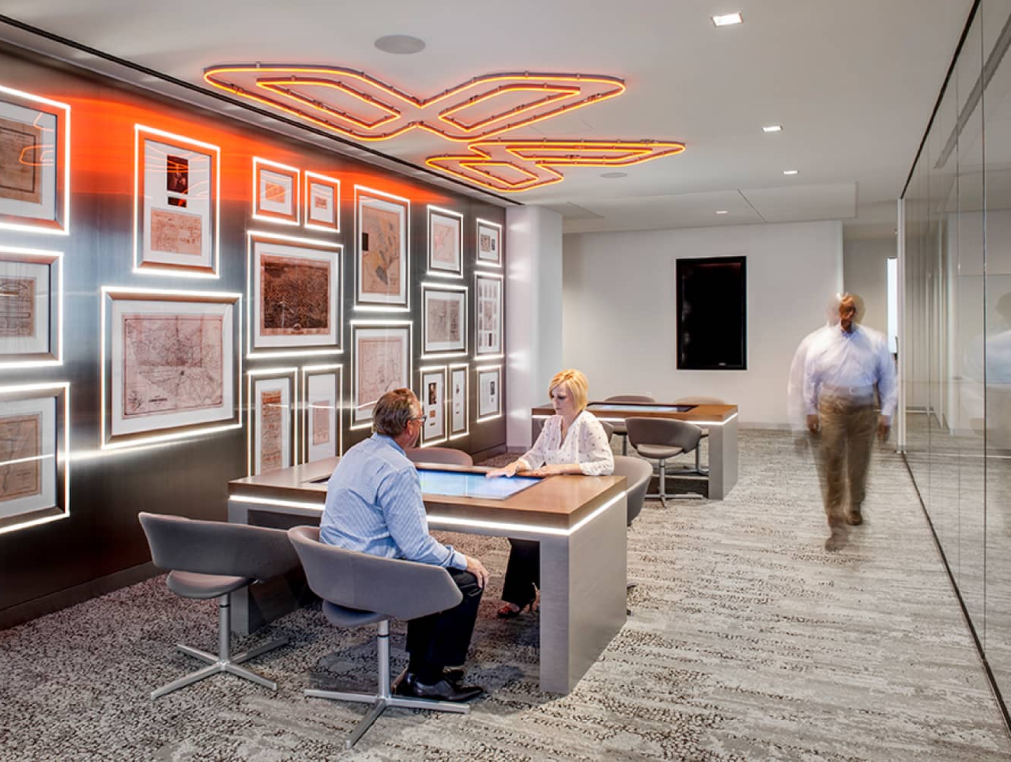
Our scope included wood veneer wall panels, entry doors and frames, casework, a concierge desk, and wine storage, all fabricated in book matched, flat cut, fumed Eucalyptus veneer with extensive end matching, sequencing, and blueprinting. The goal, as owner representative Ami Buckner described it, was to introduce warmth, character, and a sense of hospitality into a building that needed a stronger identity while creating moments that felt refined yet timeless.

That’s a brief we understand deeply. When wood is chosen not just for its beauty but for its ability to unify a space and elevate an experience, the craft decisions become exponentially more important.

The Craft: When the Veneer Doesn’t Cooperate

Every project has a moment that tests the team. At Briarlake Plaza, ours was a 55-foot-long, 12-foot-high wall featuring full-height veneer panels with several concealed doors and frames.

The specified Eucalyptus veneer was too short for the wall height. And partway through production, we discovered significant damage in the flitch that hadn’t been visible during initial inspection. A sizable portion of the project had already been produced.

That’s not a comfortable discovery. But it’s exactly where experience and craftsmanship intersect. Rather than forcing a workaround or requesting a timeline extension, our team developed creative veneer layouts that made the final result look entirely purposeful. The grain patterns, the sequencing, the transitions — everything reads as intentional. You’d never know the original plan had to change.

It’s the kind of problem-solving that doesn’t show up in the finished photos, but it’s often the difference between a project that stalls and one that delivers on time.

Beyond the veneer work, one of the most distinctive elements we produced in collaboration with Gensler was a series of custom leather-wrapped steel tube screens. These function as sculptural space dividers in both the lobby and basement levels — architectural features that define zones while maintaining visual openness. The fabrication required precise coordination between the steel framework and the leather application to achieve a balance of industrial structure and tactile warmth.

The Collaboration: Why Partnership Matters More Than Perfection

We’ve worked with Gensler on some of the most demanding projects in the Houston market, and every collaboration deepens the trust. Jill Archibald and her team were engaged partners from the earliest detailing conversations through installation, open to our input on constructability and material performance, and responsive when field conditions required real-time adjustments.

That kind of relationship isn’t built on a single project. It’s built on showing up consistently, surfacing questions early, communicating milestones clearly, solving problems before they become delays, and keeping everyone aligned on what matters most: delivering the intended design at the level of quality the project demands, on the timeline the client expects.

We applied our proven project management protocols to build a project-specific execution plan, tracked progress at every stage, and coordinated closely with Endurance Builders and the broader team to remove friction as it appeared.

The Result: A Blueprint for Office Revitalization

The repositioning has had a measurable impact. Briarlake One has secured a key anchor tenant and achieved near-full occupancy, which is a testament to how thoughtful design, material strategy, and reliable execution can drive real business outcomes.

Briarlake Plaza now stands as a model for how aging office properties can be reimagined to remain competitive. Not through flashy gimmicks, but through intentional design decisions, durable materials, and the kind of craftsmanship that makes people feel something when they walk into a space.

We’re grateful to the teams at Gensler and Endurance Builders for the trust and collaboration that made this project possible. And we’re honored that the Architectural Woodwork Institute and Design Solutions Magazine chose to feature this work.

The beauty is always in the follow-through.

Acacia is a custom millwork and commercial furniture manufacturer based in Porter, Texas, serving commercial architects and designers across the United States. To learn more about how we can support your next project, contact us today.

Walk into any restaurant that stops you mid-sentence — the kind of place where the atmosphere hits before the menu does — and there’s a good chance custom millwork is doing most of the work.

Not the lighting, though that matters. Not the furniture, though that’s part of it. The millwork. The walls, the ceiling treatment, the built-in seating structure, the way wood wraps a room and makes it feel like it was designed around you rather than assembled in front of you.

In fine dining, every surface tells a story. And the restaurants that earn devoted followings, magazine features, and years-long reservation lists almost always share one thing in common: someone made intentional, ambitious decisions about the wood in that room.

It Sets the Emotional Tone Before Anyone Sits Down

There’s a reason so many high-end restaurants lead with wood. It’s warm without being casual. It’s luxurious without being cold. And unlike stone, metal, or glass, wood has an organic unpredictability that makes a space feel alive, grain patterns that never repeat, tones that shift under different lighting, textures that invite touch.

Custom millwork takes that inherent warmth and gives it intention. A sculptural wall installation in walnut becomes the room’s signature. Geometric ceiling panels with integrated lighting define the entire spatial experience from the moment a guest walks in.

This is the difference between a restaurant that looks nice and one that feels unforgettable. Off-the-shelf paneling can look fine. Custom millwork creates an emotional response. And in hospitality, emotional response is everything.

The Acoustic Advantage

Here’s something most diners never think about but every designer should: custom millwork is one of the most effective acoustic tools in a restaurant’s arsenal.

Hard surfaces, such as concrete floors, plaster walls, glass partitions, reflect sound. In a busy dining room, those reflections compound. Conversations compete. Noise levels climb. Guests lean in, raise their voices, and leave feeling exhausted without understanding why.

Sculptural wood forms, slatted wall systems, and dimensional ceiling treatments break up sound waves in ways that flat surfaces simply cannot. Undulating wood paneling not only looks dramatic, but it also diffuses sound across multiple angles, softening the room without deadening it. Vertical slat screens create natural separation between dining zones while allowing airflow and visual connection.

The best restaurant designers understand this intuitively. They’re not choosing parametric wood walls just because they photograph well (though they do). They’re choosing them because a room wrapped in thoughtfully shaped wood sounds as good as it looks. The guest experience improves. The conversation flows more easily. The evening feels effortless.

That’s not decoration. That’s design doing its job.

Beyond Flat Panels: The Rise of Sculptural Millwork

There’s a noticeable shift happening in high-end restaurant interiors. Flat wood paneling — clean, classic, reliable — is giving way to something more ambitious. Designers are pushing into sculptural and parametric forms that treat wood as a dynamic architectural element rather than a finish material.

Think undulating wall installations where layers of milled wood create the impression of movement. Geometric ceiling compositions where faceted panels meet at unexpected angles, with linear lighting tracing the seams. Curved banquette frameworks where the millwork and the seating become one continuous gesture.

This isn’t trend-chasing. It’s a natural evolution driven by two things: advances in digital fabrication that make complex wood forms more achievable, and a growing understanding among designers that millwork can define a space’s identity more powerfully than almost any other element.

The restaurants earning design press right now aren’t the ones with the most expensive finishes. They’re the ones where the millwork does something unexpected — where wood moves, curves, and responds to the architecture in ways that feel both bold and inevitable.

The Details That Separate Good from Unforgettable

In high-end restaurant design, the visible drama gets the attention. But it’s the quieter details that separate truly exceptional millwork from work that merely looks impressive in photos.

Joinery matters. How panels meet at transitions — wood to wall, ceiling to column, banquette to floor — reveals the level of craft behind the design. Clean, tight joints with no visible fasteners signal precision. Awkward transitions or filler strips signal compromise.

Material selection matters. The species, the cut, and the grain direction all influences how the finished product reads in the space. Rift-cut white oak lays flat and modern. Book-matched walnut creates symmetry and drama. The wrong choice can make a beautiful design feel generic.

Finish matters. A hand-rubbed oil finish on walnut feels entirely different from a high-gloss lacquer, even on the same profile. The finish affects how light plays across the surface, how the wood ages over time, and whether the room feels intimate or performative.

These aren’t details most guests will consciously notice. But they’ll feel them. And the designers who care about this level of craft and who understand that the difference between good and extraordinary lives in the margins are the ones creating restaurants that endure.

Why the Right Manufacturing Partner Changes Everything

Ambitious millwork design only works if the execution matches the vision. And this is where many restaurant projects fall short — not because the design wasn’t strong, but because the manufacturing partner couldn’t deliver on it.

Complex sculptural forms require precision engineering, experienced fabricators, and a production partner who can problem-solve when the design intent meets the reality of materials, tolerances, and installation conditions. This isn’t commodity work. It requires a team that understands how wood behaves, how to translate a designer’s rendering into shop drawings that actually build, and how to deliver on a timeline that respects the brutal realities of restaurant construction schedules.

The designers we work with have learned that the manufacturing relationship is the project. A partner who communicates proactively, delivers presentation-ready drawings, responds quickly when questions arise, and shows up on time with pieces that match the approved samples isn’t just nice to have. They’re the difference between a project that lands and one that limps across the finish line.

Custom millwork is an investment. In a high-end restaurant, it’s arguably the most important investment a designer will make. The right partner protects that investment with craftsmanship, consistency, and a genuine commitment to making the designer’s vision real.

The Spaces People Remember

The restaurants we remember years later — the ones we recommend without hesitation, the ones we return to even when the menu hasn’t changed — are almost always defined by how they made us feel. And more often than not, that feeling started with the wood.

Custom millwork is the quiet force behind the most memorable dining experiences being designed today. It shapes the sound, sets the mood, defines the architecture, and gives a space the kind of character that can’t be replicated or mass-produced.

For the designers and architects creating these spaces, the question isn’t whether custom millwork matters. It’s whether they have a partner who can bring it to life — beautifully, reliably, and without the stress.

That’s what we’re here for.

Designing a restaurant that deserves to be remembered? Let’s talk about what’s possible. Schedule a conversation with our CEO, Will Fuller, today.

Ask any commercial architect or designer about their furniture vendors, and you’ll hear a familiar refrain: the good ones are hard to find, and the great ones are worth their weight in walnut.


Acacia has spent years listening to architects and designers across the corporate and hospitality sectors. Not the polite feedback they give in surveys, but the real conversations— the ones that happen when a deadline has just passed, a client presentation is tomorrow, and someone needs a partner who actually shows up.


What we’ve learned might surprise you. It’s not always about price. It’s rarely about having the biggest catalog. What architects actually want from furniture partners comes down to something simpler (and harder to deliver) than most vendors realize.


They Want Partners Who Communicate Like Colleagues

The single most common frustration we hear from A&D professionals? Silence. Emails that go unanswered for days. Quote requests that disappear into a void. Status updates that require three follow-ups to obtain.


Architects don’t need vendors who communicate like customer service representatives reading from scripts. They need partners who respond like trusted colleagues: quickly, honestly, and with the context that shows they actually understand the project.


Acacia provides proactive updates when timelines shift. We pick up the phone when something goes sideways. And we’re honest about what’s possible rather than overpromising and underdelivering. When a designer is presenting to a client next Tuesday, they don’t need corporate-speak. They need someone who will tell them straight: yes, we can make that happen, or no, here’s what we can do instead.


They Want Deliverables Ready for Client Eyes

Architects and designers aren’t the end users of their materials. Every spec sheet, every product image, every quote needs to be something that can go directly into a client presentation.


Too many vendors send technical documents formatted for internal use, cluttered with codes and abbreviations that mean nothing to a client reviewing their new lobby design. The architects then spend hours reformatting, cropping, and rebuilding materials that should have been presentation-ready from the start.


Acacia is a furniture partner who understands that our job extends beyond manufacturing. We help designers look good in front of their clients. Clean imagery. Clear specifications. Professional documentation that elevates the entire project, not just the product.


They Want Speed Without Sacrificed Quality

Commercial design operates on compressed timelines. Corporate clients want their new headquarters furnished yesterday. Hotels are racing toward opening dates that were ambitious before delays pushed construction back by three weeks.


Architects need furniture partners who can move fast, but not partners who cut corners to do it. The industry standard for custom millwork often stretches to eight weeks or more. When a partner can deliver in four to six weeks without compromising craftsmanship, they become invaluable.


Speed matters. But so does showing up with pieces that look exactly like they should. No excuses about rush timelines, no visible compromises in finish or joinery. The architects we work with have learned the hard way that fast delivery means nothing if the product needs to be replaced six months later.


They Want Problem-Solvers, Not Order-Takers

Every project has moments where the original vision meets the reality of budget, space, or timeline constraints. These are the moments that define a furniture partnership.


Order-takers quote exactly what’s requested and shrug when it doesn’t fit the budget. Problem-solvers come back with alternatives: different materials that achieve the same aesthetic at a lower cost, slightly modified dimensions that work better with the floor plan, or creative approaches that honor the design intent even when the original spec isn’t feasible.


The best partners treat a designer’s vision as the starting point, not a rigid blueprint. They ask questions. They offer options. They bring the kind of product knowledge that transforms obstacles into opportunities. That flexibility, paired with genuine expertise, is what separates vendors from true collaborators.


They Want Consistency They Can Stake Their Reputation On

Commercial architects and designers put their names on every project. When they recommend a furniture partner, they’re lending their professional credibility. Nothing damages that trust faster than inconsistency—beautiful pieces one project, quality issues the next.


What A&D professionals want is the opposite of surprise. They want to know, with confidence, that the experience they had last time is the experience they’ll have this time. Same responsiveness, same attention to detail, and same quality arriving at the job site.


This kind of consistency doesn’t happen by accident. It requires systems, quality control, and a culture that treats every project as a reflection of who you are. When architects find a partner who delivers that reliability, they stop looking for alternatives.


They Want to Feel Supported, Not Sold To

There’s a difference between a vendor relationship and a partnership, and architects can feel it immediately. Vendors push products. Partners ask about the project, the client, and the goals behind the design choices.


Designers working on high-pressure projects don’t need another salesperson in their inbox. They need someone who understands that their success is the whole point. Someone who remembers the details from the last conversation. Someone who treats their challenges as shared problems worth solving together.


The furniture partners who earn long-term loyalty are the ones who show up with warmth and precision in equal measure—professional enough to trust with complex projects, human enough to make the process feel collaborative rather than transactional.


Building Partnerships That Last

When we built Acacia, we started by listening. Not to what we assumed architects wanted, but to what they told us—in frustration, in hope, and in the quiet moments when they described what working with the right partner could feel like.


What we heard shaped everything: our commitment to radical responsiveness, our investment in presentation-ready deliverables, our focus on faster lead times without compromised craftsmanship. These aren’t marketing positions. They’re responses to real needs from the professionals we serve.


The architects and designers who choose to work with us aren’t looking for a vendor. They’re looking for a partner who makes them look good, makes their job easier, and makes the impossible feel possible. That’s what we aim to be—every project, every time.


Ready to work with a furniture partner who actually listens? Schedule a call with Will Fuller and discover what a seamless partnership can look like.


Artificial intelligence is everywhere right now. It writes emails. Generates images. Speeds up workflows. And for many industries, it’s already reshaping how work gets done.


That has sparked a familiar question, especially for younger workers and career switchers: What jobs will still matter in 10, 20, or 30 years?


Mike Rowe has been talking about this for a long time. Long before AI became a headline, he was making a simple, often unpopular point: we didn’t lose jobs—we lost respect for the people who do them. And nowhere is that more evident than in the skilled trades.


Today, as automation accelerates, that point feels more relevant than ever. Because while AI is incredibly powerful, there are entire categories of work it simply can’t replace.


Commercial woodworking is one of them.

The Work AI Is Good At and the Work It Isn’t

AI excels at speed, pattern recognition, and repetition. It’s phenomenal at handling large volumes of predictable information. And when used well, it can absolutely make teams more efficient.


But skilled trades don’t operate in predictable environments.


They operate in the real world, where materials behave differently than drawings suggest, where tolerances matter, and where judgment is required at every step.


A machine can follow instructions.
A skilled tradesperson interprets reality.


That difference matters.


In commercial millwork, no two projects are identical. Even with the same design intent, variables change:

  • Materials react differently to humidity and finish
  • Job sites introduce constraints no model can fully predict
  • Install conditions require real-time decisions


These moments aren’t errors in the process. They are the process. And they require human skill, experience, and accountability.

Why Commercial Woodworking Can’t Be Automated Away

There’s a misconception that skilled trades are “manual” and therefore replaceable. In reality, they’re deeply cognitive.


Commercial woodworking lives at the intersection of:

  • Design intent
  • Engineering precision
  • Material behavior
  • Time and budget constraints


That intersection demands judgment.


AI can assist with drawings, scheduling, and optimization. But it can’t:

  • Read grain the way an experienced craftsperson can
  • Adjust fabrication based on subtle material cues
  • Balance aesthetics and durability in the moment
  • Solve unforeseen site conditions without context 

You don’t just “make” millwork. You make decisions—constantly. That’s not something you automate. It’s a skill you develop.

The Trades Aren’t Disappearing– They’re Evolving

Another myth is that skilled trades are stuck in the past. In reality, modern commercial woodworking is more advanced than ever.


Today’s shops use:

  • CNC technology
  • Digital shop drawings
  • Project management systems
  • Precision tooling and finish processes

But technology supports craft, rather than replaces it.


The best results happen when human skill and modern tools work together, not when one tries to replace the other. That combination creates work that’s not only efficient, but deeply intentional.


This is the future of the trades: hands-on work for people who also think deeply.

Why the Skilled Trades Are Becoming More Valuable

As more careers shift toward abstract, screen-based work, something interesting is happening. People are craving work that feels real.

Work where:

  • You can see what you built
  • Quality is tangible
  • Pride isn’t theoretical


Skilled trades offer something rare: a direct connection between effort and outcome.


In commercial woodworking, when contributing to a project, you leave a physical mark on a space where people work, gather, and live. That sense of ownership doesn’t fade with time. It grows.


And as fewer people pursue these paths, the value of those skills only increases.


This isn’t a fallback career. It’s a forward-looking one.

What a Career in Commercial Woodworking Really Looks Like

The reality of modern millwork is far from the outdated stereotypes. It’s not about standing still or doing one thing forever. It’s about:

  • Developing mastery
  • Learning how systems work together
  • Understanding design, fabrication, and delivery as a whole


For people who enjoy problem-solving, precision, and building something that lasts, this work offers long-term growth, not just short-term employment.


And it offers something many people are missing: pride in the process.

Where Acacia Fits Into This Future

At Acacia, we don’t see technology and craftsmanship as opposites. We see them as partners.


Our goal isn’t to automate people out of the process. It’s to support skilled tradespeople with better tools, clearer communication, and stronger systems– so they can do their best work.


That means:

  • Respect for the craft
  • Clear expectations
  • Clean processes
  • A culture built on follow-through


We believe skilled trades deserve more than survival. They deserve respect, investment, and a future that’s worth building toward. And that belief shows up in how we work every day.

The Future Belongs to Builders

AI will continue to change how work gets done. That’s the reality. But the work that requires judgment, care, and accountability isn’t going anywhere. In fact, it’s becoming more essential.


Because no algorithm can replace pride. No automation can replace ownership. And no machine can replace the human ability to build something meaningful, with intention.


The future doesn’t belong only to those who code it. It belongs to those who build it.


And for skilled tradespeople, especially in commercial woodworking, that future is just getting started.

Explore Careers at Acacia

When commercial projects go sideways, it’s rarely because of one big mistake. More often, it’s a series of small misses, such as unclear communication, slow responses, vague drawings, and missed expectations. These small misses quietly compound until stress replaces confidence.


And too often, those issues trace back to one decision: choosing a millwork partner based primarily on price.


Price matters, of course. Budgets are real. But in commercial millwork, price is rarely the thing that determines whether a project feels smooth or painful. What matters more is how a partner works—how they communicate, how they manage details, and how consistently they follow through.


So if you’re evaluating millwork partners for an upcoming project, here’s what to look for beyond the number on the quote.


1. Clear, Consistent Communication (Before You Even Ask)


The first signal usually shows up early.


  • How quickly do they respond?
  • Do they answer the actual question, or dance around it?
  • Are their emails clear, or do they create more confusion?


A strong millwork partner doesn’t need to be chased. They communicate proactively, explain tradeoffs plainly, and flag potential issues before they become problems. In high-pressure commercial environments, responsiveness isn’t a courtesy—it’s a risk-management tool.


If a partner struggles to communicate during early conversations, it’s unlikely to improve once timelines tighten and stakes rise.


What to look for:


  • Fast, thoughtful responses
  • Clear next steps
  • Willingness to say “here’s what we recommend and why”


“Known for communication” isn’t a slogan. It’s Acacia’s daily practice.


2. Documentation That’s Built for Real Projects


Beautiful ideas don’t build themselves. Drawings do. A reliable millwork partner produces documentation that is precise, complete, and easy for designers, GCs, and installers to interpret.


That means shop drawings that anticipate questions—not drawings that trigger RFIs. It means specifications that align with reality, not just intent. The goal isn’t perfection. It’s clarity.


When documentation is clear, everything downstream moves faster:


  • Approvals
  • Fabrication
  • Installation
  • Closeout


When it isn’t, every team pays the price.


What to look for:


  • Shop drawings that are legible, detailed, and logical
  • Finish samples that match documentation
  • A clear approval process that doesn’t stall momentum


The beauty is in the follow-through.


3. A Proven Process (Not Just Talent)


Craftsmanship matters, but craftsmanship without structure can still create chaos.


Great millwork partners don’t rely on heroics. They rely on repeatable systems that keep quality high and timelines predictable, even when projects are complex.


That includes:


  • Defined production workflows
  • Quality checks at multiple stages
  • Project management that tracks details, not just dates


When a millwork partner has a real process, you feel it. Things move forward without constant reminders. Questions get answered before you know to ask them. And when something unexpected arises (as it always does) the response is calm and constructive, not reactive.


What to look for:


  • A clearly explained workflow from design through install
  • Dedicated project management
  • Evidence they’ve done projects like yours before


Cut corners? Never.


4. Respect for Design Intent (and Budget Reality)


A true partner doesn’t just execute. They collaborate. That means understanding the why behind the design, while also being honest about feasibility, lead times, and cost implications. It means offering alternatives when needed, without diminishing the integrity of the space.


The best millwork partners don’t say “no.” They say, “Here’s how we can make this work.” That balance—protecting design intent while respecting constraints—is where trust is built.


What to look for:

  • Thoughtful value-engineering options
  • Willingness to explain tradeoffs clearly
  • A solutions-first mindset


Let’s simplify the complex.


5. Realistic Timelines and Accountability to Match


Lead times are one of the biggest pain points in commercial millwork. And while delays happen, surprises shouldn’t. A dependable partner sets timelines they can actually meet—and communicates early if something changes. They don’t overpromise to win work, only to renegotiate later. 


Faster isn’t better unless it’s reliable. What matters is knowing when fabrication actually starts, when milestones are hit, and when product will arrive on site. Knowing that those dates mean something.


What to look for:


  • Transparent production timelines
  • Updates without being prompted
  • A track record of on-time delivery


Acacia isn’t the loudest—we’re the most consistent.


6. Integrity You Can Feel


This one’s harder to quantify, but impossible to fake.

Do they:


  • Own mistakes?
  • Follow through on commitments?
  • Treat your team with respect, even under pressure?

Integrity shows up in the small moments—how issues are handled, how boundaries are respected, how consistently people do what they say they will do. Over time, those moments add up to something invaluable: trust. And trust is what allows designers to focus on design instead of damage control.


What to look for:


Always responsive. Always respectful.


Price Is Just the Starting Point


The lowest number on a proposal rarely tells the full story.


What really matters is whether a millwork partner:


  • Reduces stress instead of adding to it
  • Helps projects move forward instead of stalling them
  • Makes you feel supported, informed, and confident


When those things are present, projects don’t just get built—they get delivered with pride. And that’s worth far more than a line item.


Choosing a commercial millwork partner is less about finding the cheapest option and more about finding the one who shows up consistently, communicates clearly, and treats your project like it matters.

Because it does.


And when the right partner is in place, the process doesn’t just work. It feels genuinely seamless.

In millwork, the finished piece gets the spotlight. The clean lines. The flawless joinery. The quiet confidence of something made right.

But great millwork doesn’t start in the shop—it starts with people. With how they treat one another. With the standards they hold when no one’s watching. With the values that guide decisions long before wood ever meets blade.

At Acacia, our values aren’t words on a wall or lines in a handbook. They’re practical. They’re lived. And they shape everything from how we collaborate as a team, to how we serve architects and designers, to how we invest in the next generation of millwork talent.

Here’s what that looks like in action.

Honor: Respect Is the Foundation of Craftsmanship

We believe honor is foundational not just to our culture, but to our outcomes. Every role at Acacia matters, and every voice deserves respect.

In practice, that means our shop team, project managers, engineers, and leadership work as partners, not silos. Decisions are made with awareness of downstream impact. Feedback travels both directions. Credit is shared. Accountability is mutual.

When people feel respected, they do their best work. And in custom commercial millwork, the best work is never accidental.

Integrity: Doing What We Say We’ll Do– Every Time

Integrity is simple. It’s also non-negotiable.

At Acacia, integrity shows up in follow-through. In transparent timelines. In owning mistakes quickly and fixing them decisively. In telling clients the truth (even when it’s uncomfortable) because trust is worth more than short-term convenience.

This commitment extends internally, too. Team members know what’s expected of them, and they know leadership will hold the same standard. That consistency creates stability– and stability allows people to focus on craftsmanship, not politics.

Cut corners? Never.

Communication: Clear, Open, and Human

Millwork projects are complex. People don’t need more noise. They need clarity.

We value communication as a cornerstone of our culture, which means we prioritize clear expectations, proactive updates, and open dialogue across departments. Questions are welcomed. Different perspectives are explored. Problems are solved collaboratively, not quietly avoided.

This is one reason designers trust Acacia: they’re never left guessing. And it’s also why our team thrives– because no one is operating in the dark.

Good communication isn’t flashy. It’s just relentlessly reliable.

Passionate Excellence: High Standards, Deep Pride

We care deeply about what we make and how we make it.

Passionate excellence at Acacia means operating to high standards every single day, fueled by pride in the craft and commitment to the outcome. It’s why our team sweats details others overlook. Why quality checks are rigorous. Why “good enough” isn’t in our vocabulary.

But excellence here isn’t about ego. It’s about responsibility to the client, to the team, and to the spaces our work will live in for decades.

Beautiful solutions. Zero drama.

Pioneering Spirit: Always Asking “How?”

The millwork industry doesn’t change quickly, but that doesn’t mean it shouldn’t evolve thoughtfully.

We believe in a pioneering spirit: pursuing better ways to work, taking calculated risks, and innovating with purpose– and Acacia is always looking ahead.

Importantly, innovation here is collaborative. We listen actively. We adapt quickly. And we build systems that make life easier for designers and makers.

We’re not here to follow. We’re here to build what’s next.

Exceptional Experiences: For Clients and Each Other

Exceptional experiences don’t happen by accident. They’re designed.

For our clients, that means responsive communication, reliable lead times, and millwork that shows up exactly as promised. For our team, it means a workplace where people feel supported, challenged, and proud of what they contribute.

We believe the internal experience directly shapes the external one. When the team feels valued and empowered, the work reflects it.

Inspiring: Activating Potential

Leadership at Acacia isn’t about hierarchy. It’s about helping others grow.

We strive to inspire through clarity, authenticity, and trust. Team members are encouraged to stretch, to lead, and to bring forward ideas. Wins are celebrated. Lessons are shared. Growth is intentional.

The goal isn’t just to build great millwork. It’s to build great people who are confident in their craft and their future.

Revering Resources: Craft With Responsibility

Wood is a gift. So is time. So are people.

We take seriously our responsibility to use resources wisely–material, human, and environmental. From efficient production practices to thoughtful sourcing, we work to preserve what matters for the next generation of makers.

Sustainability isn’t a marketing checkbox here. It’s part of honoring the craft itself.

Reproducing Talent: Building the Future of Millwork

Perhaps the value we’re most proud of is our commitment to developing talent.

The millwork industry depends on skilled craftspeople, and those skills don’t appear overnight. Acacia invests in mentorship, training, and career pathways that help individuals not just succeed, but surpass those who came before them.

We don’t ask where someone’s potential has been. We ask where it can go.

This belief is core to who we are and where we’re headed.

Why This Matters 

If you’re a millwork professional looking for more than just a job—if you want to work somewhere that values craftsmanship and people—culture matters.

At Acacia, you’ll find a team that listens, communicates clearly, and holds itself to a high standard without losing its humanity. A place where the beauty truly is in the follow-through. Where growth is encouraged. And where the work you do matters.

We’re known for communication. Trusted for quality. Chosen for results.

And we’re just getting started.

Acacia’s core values—Honor, Integrity, Communication, Passionate Excellence, Pioneering Spirit, Exceptional Experiences, Inspiring leadership, Revering Resources, and Reproducing Talent—guide how our team shows up every day and shape the culture we’re proud to build together.

The Human Side of Building Beautiful Things

At Acacia, we’ve always believed the work we do is about more than wood, finishes, or fast turnarounds. It’s about people – the ones who show up every day with steady hands, sharp minds, and genuine pride in what they build.

We invest in people before projects. We believe that craftsmanship isn’t just a skill; it’s a reflection of culture.

Walk through our workshop on any given day and you’ll see what that looks like in action. Laughter between teammates over the hum of a planer. A new apprentice learning from a master who’s been here for fifteen years. A production engineer double-checking a detail that no one else would ever notice… but we will.

We’re not just shaping wood. We’re shaping futures. And that’s a responsibility we take seriously.


Inside Acacia’s Workshop: Where Craftsmanship Meets Care

When we talk about careers at Acacia, what we’re really talking about is opportunity.

We hire people who love working with their hands – and then give them every reason to love where they work. That means clear communication, transparent leadership, and a culture that prizes curiosity over ego. We make mistakes, we learn fast, and we keep improving together.

Our workshop isn’t about assembly lines; it’s about alignment of craft, purpose, and people. Every project, from a custom hospitality buildout to a corporate boardroom, is treated with the same level of intention. Every joinery choice, veneer match, and finish schedule is a reflection of the people behind it.

And those people are the heart of Acacia.

We take care to ensure every craftsman and designer understands the “why” behind the work, not just the “how.” When you know what your work means to the architect, the client, and the space itself, you build differently. You build with care.

Employee Profit-Sharing, Growth, and Purpose

At Acacia, every employee is directly connected to the company’s success through an employee profit-sharing program that rewards performance, consistency, and collaboration.

When a project exceeds expectations, it’s not just a win for the client, it’s a win for the team who made it happen. That shared success shows up every quarter in tangible ways, but more importantly, it shows up every day in how our people approach their work.

We see it in the care our craftsmen take with every panel. In the pride our project managers bring to every installation. And in the mentorship that happens naturally when experienced makers pass along what they’ve learned to the next generation.

Ownership inspires excellence. When you have a stake in the outcome, you act like it. But profit-sharing is just one piece of how we invest in growth. We also create real career paths: from apprentice to journeyman, from journeyman to leader. We pair that with education, safety training, and leadership development because we want our people to stay and grow here for the long haul.

We’ve seen first-hand how that commitment changes everything: morale, productivity, and quality all rise together. When people feel seen, respected, and rewarded, they build things they’re proud to sign their name to.

The Link Between Culture, Quality, and Consistency

Culture isn’t the soft stuff. It’s the system that powers the hard stuff.

At Acacia, our culture is one of the reasons architects and designers trust Acacia with their most complex projects. They know that when our name is on the spec sheet, the work will get done right– on time, on budget, and beautifully executed.

Culture shows up in the final product. You can see it in the fit of a miter, the flow of a grain pattern, the ease of installation. You can even feel it when you walk into a space we’ve built. There’s a calm precision to it– the quiet confidence of a team that cares deeply about every detail.

That’s what craftsmanship culture produces: consistency with soul.

Why It Matters and Why It Lasts

In manufacturing, machines can replicate precision. But only people can replicate pride.

That’s why we work so hard to create an environment where pride thrives, where good work gets noticed, voices get heard, and every role matters. From the shop floor to the executive table, we share the same mission: to turn complexity into clarity, and materials into meaning.

As we grow, our commitment doesn’t change, it strengthens. Every new hire, every new project, every new client gives us another chance to prove that craftsmanship isn’t just a department. It’s a culture.

And we’re building one worth belonging to.


See What It Means to Build with Heart

If you’re looking for a place where skill meets purpose, where your work is valued, your ideas matter, and your growth is built into the plan, we’d love to meet you.

Explore careers at Acacia and see why we’re building more than beautiful spaces. We’re building a community of craftsmen who believe the beauty is in the follow-through.

View Open Positions

In the world of design, details aren’t small, they’re everything. They’re what turn a room into an experience. A lobby into a story. A workspace into a statement of confidence.

When you step into a well-designed space, you might not notice the millwork right away, but you’ll feel it. The perfect grain alignment, the flawless joinery, the way light catches a satin finish– all of it speaks to a level of care that can’t be faked.

At Acacia, we believe high-end architectural millwork isn’t just about craftsmanship. It’s about commitment– to the designer’s vision, to the project’s purpose, and to the small details that make a big impression.

What Separates Premium Millwork from Standard Casework

To the untrained eye, casework and architectural millwork can look similar. Both involve woodworking, precision, and installation. But in reality, they serve very different roles in the built environment, and their impact couldn’t be more distinct.

Casework is built to be functional: cabinets, storage systems, or fixtures that serve a clear utilitarian purpose. It’s often manufactured in volume, following standard dimensions and finishes. Good casework is dependable and efficient.

Architectural millwork, however, is where craftsmanship and artistry meet. It’s fully customized, designed to integrate seamlessly into the architecture, enhance aesthetics, and express identity. It’s not built for a space; it’s built into it.

Premium millwork requires more than precision machinery. It requires human judgment and creative alignment. Every detail, from veneer sequencing to joint reveal width,  is an intentional decision that affects the final impression of a space.

Where standard casework follows a pattern, high-end architectural millwork defines the atmosphere. It tells the story of a brand, a culture, or a design philosophy through material and proportion.

That’s why the best designers don’t just specify woodwork. They specify craftsmanship.

Acacia’s Process: Material Selection, Matching, and Finishing

When Acacia was chosen to fabricate the architectural millwork for Maverick Natural Resources’ corporate headquarters in Houston, we knew the project would demand a different level of precision and artistry. The design, led by Abel Design Group, called for a space that communicated strength, sophistication, and clarity– the same qualities that define Maverick’s brand.

Every element was intentional. Every material had meaning.


Symbols and Design

Material Selection: Setting the Tone

The design team envisioned a light-toned Walnut– elegant, natural, and warm, but refined enough for an executive environment. Finding the right flitch (or log slice) was critical.

Our sourcing partner, The Wood Gallery, combed through countless veneer bundles to find Walnut with the right balance of color, texture, and linearity. Even the smallest tonal shift could have disrupted the visual rhythm of the space.

When the right material finally arrived, our team inspected every leaf under controlled light to confirm color consistency and grain clarity, hallmarks of high-end architectural millwork.

Veneer Matching: Creating Flow

Natural veneer is unpredictable. No two sheets are identical, which is both its challenge and its beauty. To achieve a continuous, uninterrupted visual flow across walls, ceilings, and furniture, Acacia employed a combination of book matching, sequence matching, and blueprint matching.

These advanced techniques allowed us to align every grain, every curve, and every shadow precisely with the architect’s drawings. The result wasn’t just millwork, it was movement. A natural rhythm carried across rooms, connecting spaces both visually and emotionally.


Symbols and Design

Finishing: Where Craft Meets Chemistry

Even the finest wood can fail without the right finish. In this project, the Walnut underwent a custom bleaching and staining process to achieve the soft, striated tone the designers envisioned, one that projected lightness without losing depth.

This process required extensive testing to ensure the finish met both aesthetic goals and AWI millwork quality standards for durability and colorfastness. Each surface was hand-sanded between coats, ensuring a silky touch that felt as refined as it looked.

The end result was a space that blended strength and serenity, an environment where leadership could make decisions surrounded by materials that reflect focus, precision, and trust.

As Maverick’s executive team shared: “It communicates who we are — strong, grounded, and purposeful.”

Why Designers Trust Partners Who “Cut Corners? Never.”

In high-pressure commercial design, time is money, but cutting corners costs more. The difference between a trusted millwork partner and an average fabricator often comes down to how they handle the moments you don’t see:

    • The proactive question before a mistake becomes expensive.
    • The re-engineered joint that saves a finish from cracking.
    • The extra day spent matching veneers so a wall feels seamless instead of stitched together.

At Acacia, precision craftsmanship isn’t just a tagline, it’s a promise. Every project is a reflection of our client’s reputation and our own. That’s why we’re known not just for meeting specifications, but for anticipating them.

We believe that great millwork doesn’t happen in the shop alone. It happens in collaboration between designers who dream, engineers who translate, and craftspeople who execute with discipline and care.

Our process is designed to make life easier for designers, not harder. That means:

    • Early communication. We engage during schematic and design development to identify potential issues before fabrication begins.
    • Detailed documentation. Every Acacia submittal package is formatted for clarity. No guesswork, no surprises.
    • Consistent follow-through. Once the shop drawings are approved, our schedule is our promise.

When we say no corners were cut, we mean it literally and philosophically.


The Acacia Team Photo

The Standard We Live By

Millwork quality standards, such as those set by the Architectural Woodwork Institute (AWI), exist for a reason: to ensure that beauty isn’t just surface deep. But while standards provide a baseline, our goal is to exceed them.

We approach each project with the mindset that it should feel crafted, not manufactured. From hand-checking finishes to blueprint matching veneers on large-format walls, every gesture is part of our pursuit of something timeless.

Because the real beauty of high-end architectural millwork isn’t just in how it looks, it’s in how it endures.

The Takeaway: Details Define Trust

In a marketplace full of manufacturers, the rarest quality isn’t speed or scale, it’s care.

At Acacia, we’ve built our reputation on three words: communication, quality, and results.

For architects and designers, we’re more than a vendor. We’re the partner who listens first, follows through always, and never compromises the details that make your work extraordinary.

So whether you’re designing a corporate headquarters, boutique hotel, or executive suite, remember: It’s the details that define the space. And it’s the follow-through that defines the partnership.

Let’s build something beautiful together. Get in touch with Acacia to discuss your next project, request samples, or schedule a design consultation.

Commercial construction is a world where deadlines rule. Miss a milestone, and the ripple effect can throw off budgets, strain client relationships, and jeopardize the success of the entire project. Architects and designers know this pressure all too well– especially when it comes to custom millwork. Custom casework, feature walls, and high-impact wood details are often the final touch clients see, yet they’re also among the most complex and time-sensitive elements to produce.

That’s why early millwork collaboration isn’t just a “nice to have.” It’s the difference between finishing on time with confidence or scrambling to patch problems when it’s already too late. Partnering with a trusted commercial millwork partner from day one gives your team a crucial edge in millwork project management, aligning design intent with real-world constructability, material availability, and production schedules.

In short: the earlier you bring your millwork partner into the conversation, the more seamless (and on time) your project delivery will be.

The Problem with Waiting Too Long

Too often, millwork is treated as a downstream scope. Architects finalize designs, engineers issue plans, and only then does the millwork fabricator get looped in. By this point, key decisions, like materials, profiles, dimensions, budget allocations, have already been made without the input of the people responsible for actually building it.

The consequences?

      • Delays: When design intent collides with fabrication reality, redesigns or revisions can add weeks to already tight commercial millwork timelines.
      • Budget drift: Without early alignment, pricing surprises creep in, forcing teams into last-minute value engineering exercises.
      • Compromised design: What looked beautiful on paper may need to be stripped back or reimagined under the pressure of time and cost.


This reactive approach almost guarantees stress, inefficiency, and schedule risks.

Early Millwork Collaboration: A Smarter Approach

When you bring your commercial millwork partner into the project during design development, the entire process shifts from reactive to proactive. Instead of playing catch-up, the millwork team becomes a strategic partner in shaping solutions that are buildable, affordable, and achievable within your timeline.

Here’s what early collaboration unlocks:

1. Constructability Insights from Day One: Experienced millwork teams can spot red flags in drawings and offer practical adjustments before they become costly problems. Is that curve achievable in solid wood, or would a veneer over a bent substrate deliver the same look more efficiently? Will those intricate profiles create issues with finishes or durability? Early answers prevent late-game headaches.

2. Material Alignment and Procurement: Exotic veneers, specialty laminates, or oversized lumber aren’t always sitting on a shelf ready to ship. Lead times can stretch weeks or months. Early involvement allows your partner to identify material constraints upfront, source alternatives, and secure inventory so fabrication doesn’t bottleneck the schedule.

3. Budget Predictability: Nobody likes surprises, especially owners and developers. Early budgeting support ensures that cost expectations are realistic from the start, reducing the risk of painful redesigns or concessions later. Your custom millwork partner can also flag where design details drive cost– and where small adjustments could free up budget without sacrificing design intent.

4. Streamlined Project Management: When your millwork partner is looped into scheduling and coordination early, they can align production with construction milestones. This proactive approach to millwork project management reduces downtime, eliminates rework, and ensures millwork delivery slots seamlessly into the construction sequence.

The Impact on Commercial Millwork Timelines

Every construction project has its critical path—the sequence of tasks that directly impacts completion. Millwork nearly always falls on it. The sooner fabrication starts, the more room there is to handle the unexpected. Conversely, the later millwork is engaged, the tighter (and riskier) that timeline becomes.

By engaging a commercial millwork partner early, you:

      • Gain weeks back in your schedule through proactive approvals and shop drawings.
      • Lock in material availability before supply chain delays become an issue.
      • Ensure installation dates line up with site readiness, avoiding costly idle crews.

This results in greater confidence that your millwork won’t be the reason your project misses its deadline.

What Architects and Designers Gain

For design teams, early millwork collaboration means more than just hitting deadlines. It also protects the integrity of your design. When you know your millwork partner is problem-solving alongside you, you gain:

      • Clarity: Immediate answers to “can we build this?” questions.
      • Confidence: Assurance that your design will not just look good on paper, but function beautifully in the real world.
      • Credibility: Fewer surprises mean smoother presentations to clients and stronger trust in your leadership.


Choosing the Right Commercial Millwork Partner

Of course, not all millwork shops operate the same way. Choosing the right partner early makes all the difference. Look for a team that brings:

      • Proven project management systems to keep schedules on track.
      • Experience with complex, large-scale projects in corporate, hospitality, and institutional markets.
      • Collaborative culture that prioritizes listening, problem-solving, and clear communication.
      • A track record of on-time construction projects that prove they can deliver under pressure.

At Acacia, we pride ourselves on being that partner by bridging timeless craftsmanship with proactive project leadership.

The Bottom Line

Bringing a commercial millwork partner into your project early is one of the simplest, most effective ways to ensure on-time construction projects. It transforms millwork from a stress-inducing bottleneck into a source of confidence and creativity.

When design teams, contractors, and millwork fabricators collaborate from day one, projects don’t just finish on time– they finish beautifully. Budgets hold. Clients are delighted. And your reputation as a designer who delivers under pressure grows stronger with every project.

At Acacia, we’re here to make that process seamless. Our team is here to simplify the complex, eliminate surprises, and deliver results that make you and your projects shine. Because in the end, the beauty isn’t just in the millwork itself. It’s in the follow-through. And early partnership is where that success begins.

How Acacia partners with Architects & Designers to simplify complexity, protect budgets, and deliver with precision.

Designing commercial architectural millwork isn’t for the faint of heart. Especially in the corporate and hospitality sectors, where every detail matters and expectations run high.

And yet, despite the talent, experience, and care that designers bring to the table, the process of detailing custom millwork is still often an exercise in frustration. You’re asked to produce complete and coordinated drawings without the constructability input, budget guardrails, or fabrication guidance needed to do it confidently.

So what happens?

Budgets drift.
Timelines tighten.
Trust erodes.

That’s a burden designers shouldn’t have to bear.

At Acacia, we don’t just understand that. We’ve built an entire company to fix it.

You Design. We Help You Deliver.

Acacia isn’t just a millwork fabricator. We’re your thought partner.

We work with commercial architects and interior designers from day one, providing real-world insight that protects your vision, your process, and your reputation.

We don’t just build. We collaborate during design development, offering constructability feedback, material recommendations, and budget-aligned alternatives before anything gets locked in. And when needed, we’ll even help value engineer complex details without watering down your design intent.

Because for us, this work isn’t about pushing product. It’s about making you look good and making sure the process never puts your credibility at risk.

Why Architectural Millwork is Often So Complex

Let’s break down the problem many firms face:

  1. Designers are expected to finalize millwork packages early. Yet you’re not given access to fabrication partners early enough to stress test your concepts.
  2. Contractors want pricing clarity fast. But without fully vetted drawings or scope clarity, that’s almost impossible.
  3. Fabricators aren’t always engaged until after CDs. Which means missed opportunities for smarter construction details, faster approvals, or proactive budgeting.

The result? Endless RFIs. Jobsite delays. And far too much design compromise.

A Better Way: Side-by-Side Partnership from Day One

What’s different about Acacia’s approach to custom architectural millwork?

We sit with the designer, not behind the scenes. Here’s what that looks like:

Early Constructability Reviews

We review your initial drawings with a builder’s lens. We’ll flag potential material conflicts, dimensional challenges, or hardware limitations before they become field issues.

Real-Time Budget Alignment

Rather than getting hit with sticker shock in CD pricing, our team helps validate cost ranges during schematic and DD phases, giving you confidence early, and leverage later.

Honest Material + Finish Suggestions

We understand how to match aesthetic goals with material realities. From veneer selection to finish durability, we provide options that look great, perform well, and respect the budget.

Seamless Coordination with GCs and Millworkers

We’ve built strong relationships with construction partners across Texas and beyond. When GCs like O’Donnell Snider Construction see Acacia on a job, they know things will run smoother and faster.

The Tools Behind the Process

It’s not just our people. It’s our systems. We’re known for some of the most thoughtful, detailed, field-ready drawings in the business. Clients like Abel Design Group and J. Tyler Services regularly praise how we think through not just the design, but the install realities. We’re also known for our proactive follow-up. We don’t wait for a problem to pop up. Our team follows through at every phase, ensuring no question goes unanswered and no stakeholder feels in the dark.

Why The Acacia Approach Works

Designers don’t just want a pretty product. They want peace of mind.

They want partners who anticipate challenges, solve problems before they hit the jobsite, and protect their credibility in front of clients. That’s what Acacia offers and that’s why most of our partners become repeat collaborators.

From Fortune 500 workplace interiors to award-winning hospitality spaces, our work speaks not just through wood and finish, but through relationships built on respect, responsiveness, and results.

Bottom Line: Protect Your Process with Acacia

Custom and complex millwork doesn’t have to be painful. Not when you’ve got the right partner: one who shows up early, stays involved, and sweats the details so you don’t have to. We’ll help you turn ideas into execution beautifully, and without the drama.

Let’s Talk About Your Next Project

Designers: Want to protect your process and elevate your results?

Meet with Will Fuller to start your partnership.